When someone searches “Website Development cost in Melbourne”, they’re usually not just looking for a number.
They’re trying to understand what they’re stepping into.
Because somewhere between browsing themes, speaking to a few web development companies in melbourne, and getting that first quote… things stop feeling simple.
At first, it looks straightforward.
A few pages. Clean design. Contact form.
Then the questions start showing up.
- Will this website actually bring enquiries?
- Do I need SEO from day one?
- Why is one agency quoting $3,000 and another quoting $12,000 for what sounds like the same thing?
That’s usually the point where people realise—this isn’t just about building a website.
It’s about building something that needs to work.
Where the confusion actually begins
Most business owners start with a rough budget in mind.
Usually somewhere around $2,000–$3,000.
That number doesn’t come from research—it comes from assumptions. Maybe a past experience. Maybe something they’ve heard.
And to be fair, you can find affordable website development in melbourne in that range.
But very quickly, the conversation changes.
Someone brings up SEO.
Someone talks about performance and speed.
Someone mentions user experience, structure, and conversions.
Now suddenly, that same “website” isn’t the same anymore.
Not all websites are built for the same outcome
Two businesses can ask for a “5-page website” and expect completely different results.
One just wants a presence.
Something to share when someone asks, “Do you have a website?”
The other expects that website to:
generate enquiries
rank on Google
represent the brand properly
On paper, both are asking for the same thing.
In reality, they’re not even close.
And this is where website development pricing in melbourne starts to make sense—because the cost is tied to the outcome, not just the build.
A quick example of Melbourne business
A Melbourne-based home services business came in wanting a simple website.
Initial expectation: around $3,000.
Once we mapped what they actually needed—
location-based pages, SEO structure, enquiry flow, mobile optimisation—the project shifted.
Not dramatically. But meaningfully.
The final build sat closer to $6,500.
Within a few months, the website wasn’t just “live”—it was bringing consistent enquiries through search.
That’s the difference between a website that exists and one that contributes.
Why prices feel inconsistent
If you’ve spoken to a few agencies, you’ve probably noticed this already.
Two quotes. Same brief. Completely different pricing.
That’s because they’re not pricing the same thing.
One is pricing delivery.
The other is pricing performance.
A basic business website design in Australia might look identical on the surface—but what’s happening underneath (structure, SEO readiness, speed, conversion flow) is what changes everything.
And that part is rarely explained clearly.
What usually happens in Melbourne projects
A Melbourne-based eCommerce client started with Shopify.
The initial plan was simple—get the store live quickly.
But once real requirements came in—
custom product pages, app integrations, checkout optimisation, speed improvements—the scope expanded.
The original idea of a $5K store turned into a $12K–$15K eCommerce website.
Not because of upselling.
Because real-world needs showed up during the process.
And that’s normal.
Where costs quietly increase
This is the part most blogs skip.
Costs don’t jump because of “design.”
They increase because of decisions like:
We’ll need online booking
Users should be able to log in
We want to rank for local searches
Can this connect with our CRM?
Each addition feels small at the time.
But together, they shape the entire project—and the cost.
Cheap websites — what usually follows
There’s a pattern here.
A business goes for a low-cost option—something quick and affordable.
It looks fine initially.
But within months:
it doesn’t rank
it loads slowly
it doesn’t generate leads
So they rebuild.
What started as a $2,000 decision turns into a $7,000–$10,000 total spend.
Not because they made a mistake—
but because the first version wasn’t built with the right intent.
A more useful way to think about cost
Instead of asking:
“How much does a website cost in Australia?”
A better question is:
“What do I need this website to do for my business?”
Because that changes everything.
If it’s just for credibility → keep it simple
If it’s your main lead source → invest in SEO and structure
If you’re scaling → think long-term from day one
Once that’s clear, pricing stops feeling random.
Where most businesses land
After going through this process, most businesses settle somewhere realistic.
Not at the cheapest end.
Not at the extreme high end.
But in that middle range where the website is expected to perform.
For most small to mid-sized businesses in Melbourne , Australia, that typically means:
investing enough to ensure the website:
loads fast
ranks properly
converts visitors into enquiries
If you’re planning this right now
Before you compare quotes or platforms, take a step back.
Get clear on:
what success looks like for your website
how people will find it (SEO, ads, referrals)
what action they should take once they land
Once you have that clarity, decisions around cost, platform, and features become much easier—and far more logical.
Before You Compare Quotes, Do This First
If you’re planning a website right now, it’s worth pausing before jumping into comparisons.
Take a step back and get clear on a few things:
What does success look like for this website?
How will people find it—SEO, ads, or referrals?
What should a visitor do once they land on it?
These answers shape everything that follows—platform, features, and ultimately, cost.
Without this clarity, it’s very easy to compare the wrong things.
Choosing the Right Website Development Approach
If you’re currently exploring website development services in Australia, it helps to approach this differently.
Most people start by discussing design or number of pages.
That’s usually the wrong starting point.
A better approach is to begin with direction.
At Eoan Technologies, most projects don’t start with layouts or features.
They start with a simple but important question:
What should this website realistically do for your business over the next 6–12 months?
Once that’s clear, everything else—structure, scope, and cost—falls into place much more naturally.
And more importantly, you avoid building something that looks good but doesn’t deliver.
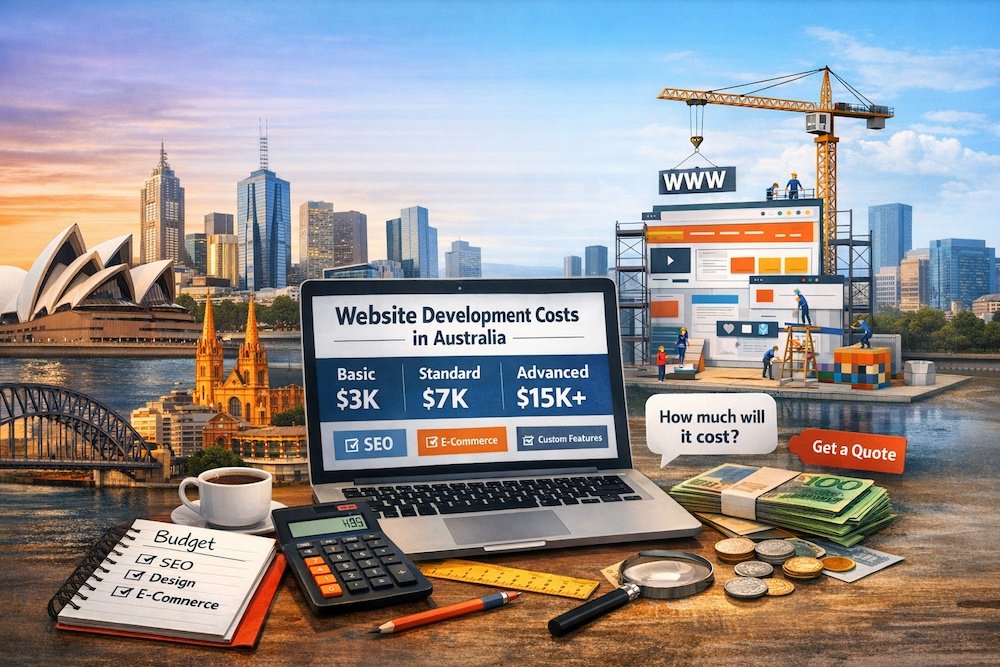
Website Development Cost in Australia