
Most dental practices in Australia are not getting the patient flow they should from Google. Not because SEO is complicated — but because they are doing the wrong things, in the wrong order, with the wrong expectations.
This is not a guide full of generic advice you have read before. It is a practical breakdown of what actually drives new patient enquiries from Google for Australian dental practices in 2026, what has changed, and exactly where to focus your effort.
Start Here — How Patients Actually Find Dentists in Australia
Before anything else, understand this: the majority of new patient searches happen on a mobile phone, within five kilometres of home, in the evening or on the weekend.
The search is usually one of three things:
- “Dentist near me”
- “Dentist [suburb name]”
- “[Treatment] dentist [suburb]” — for example, “Invisalign dentist Penrith” or “emergency dentist Fitzroy”
Notice what is not in any of those searches: your practice name. New patients do not know you exist yet. They are finding whoever Google decides to show them first.
That is the whole game. And winning it is more achievable than most practices realise.
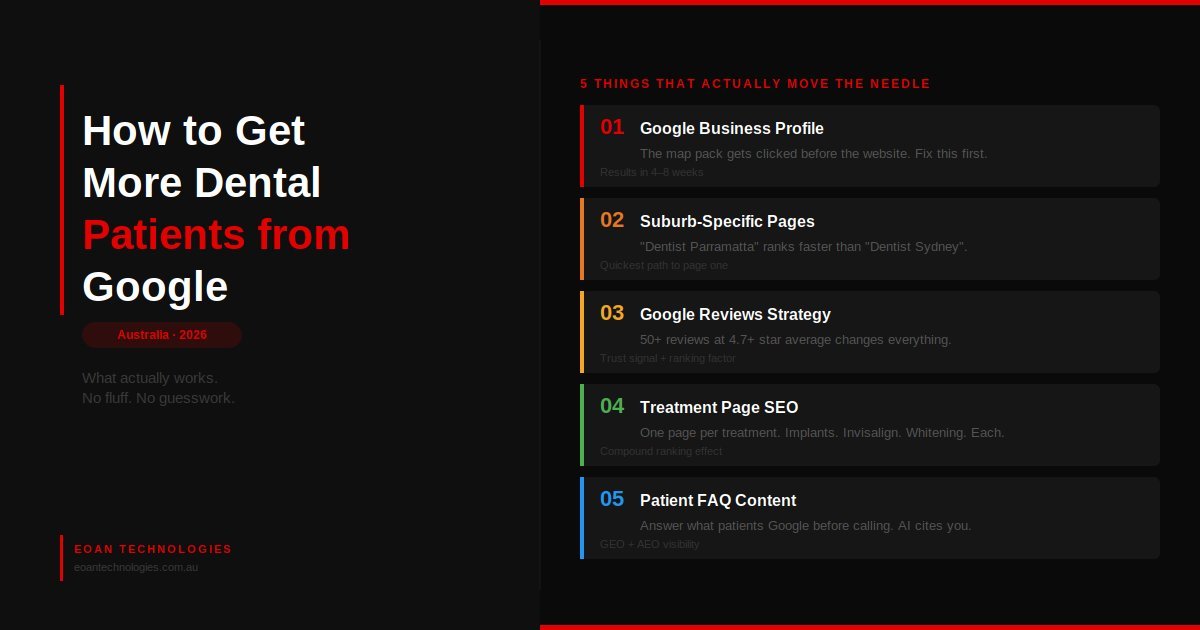
1. Your Google Business Profile Is More Important Than Your Website
If you had to choose one thing to fix this week, it is your Google Business Profile. Not your website. Not your ads. Your GBP.
When someone searches “dentist near me” or “dentist [suburb]”, they see the map pack — three GBP listings with stars, opening hours, and a click-to-call button — before they ever see a single organic website result. That map pack drives more direct patient enquiries than anything else in local search.
And most dental practice GBP profiles in Australia are incomplete, under-optimised, or outright neglected.
Here is what a properly optimised GBP profile looks like:
Categories set correctly. Your primary category should be “Dentist.” Add secondary categories for your core services — “Cosmetic Dentist,” “Emergency Dental Service,” “Dental Implants Periodontist” where applicable. Category selection directly affects which searches your listing appears in.
Every field completed. Business description written with your key services and suburb mentioned naturally. Opening hours accurate including public holiday hours. Website URL pointing to the right page. Phone number click-to-call enabled.
Photos updated regularly. Practices with 20 or more photos get significantly more views and clicks than those with two or three stock images. Real photos of your practice, your team, and your treatment rooms perform better than anything generic.
Weekly posts published. GBP posts are chronically underused by dental practices. A weekly post — a treatment spotlight, a patient education tip, a seasonal reminder — tells Google that your profile is active and managed. It also shows up in your listing for local searchers.
Questions and reviews managed. Respond to every review, positive or negative. Respond to questions in the Q&A section before patients answer them for you. An unanswered negative review on a dental GBP profile loses more patients than most practices realise.
Get all of this right and you can see measurable improvement in local pack visibility within four to six weeks. It is the fastest-returning SEO action available to any dental practice.
2. Stop Targeting “Dentist Sydney” — Start Targeting “Dentist Leichhardt”
Here is the mistake that costs practices months of wasted effort: competing for broad city-level keywords before earning suburb-level rankings.
“Dentist Sydney” has enormous search volume and enormous competition. Established practices, large dental chains, and comparison sites with massive domain authority dominate those results. A new or mid-size practice chasing that term is fighting a battle they will not win for 12 to 18 months at minimum.
“Dentist Leichhardt” — or whatever your suburb is — has lower volume but dramatically lower competition, much faster ranking timelines, and crucially, searchers who are geographically primed to actually visit your practice.
This is not a consolation prize. Suburb-level searches convert at a higher rate than city-level searches because intent and proximity are aligned. Someone searching “dentist Leichhardt” is in Leichhardt or nearby. They are ready to book.
The practical implication: create a dedicated page on your website for your suburb. Not a generic services page — a page specifically about your dental practice serving [your suburb] patients. Include the suburb name in your title tag, H1, and naturally throughout the content. Mention nearby landmarks, local hospitals, the suburb’s character. Make it genuinely local, not just a keyword replacement.
Once you rank confidently for your primary suburb, build pages for adjacent suburbs your practice draws patients from. A dental practice in Parramatta might build suburb pages for Westmead, Merrylands, Wentworthville, and Granville over time — each one capturing a distinct search audience.
3. Google Reviews Are a Ranking Factor. Treat Them That Way.
There is a common misconception that Google reviews are purely a trust signal for patients choosing between practices. They are that — but they are also a direct ranking factor in local search.
Practices with more reviews, higher average ratings, and more recent reviews consistently rank above practices with fewer reviews, all else being equal. Google interprets review volume and recency as evidence of an active, reputable business that patients trust.
The benchmark to aim for: 50 reviews at 4.7 stars or above puts you in a competitive position in most Australian suburban markets. In high-competition metro areas, 100 or more is realistic for the market leaders.
Getting there is not about luck. It is about having a consistent process.
The most effective approach is simple: at the end of every successful appointment, the front desk or treating dentist asks the patient directly — “Would you mind leaving us a Google review? It takes less than two minutes and it really helps us.” Combined with an SMS or email follow-up containing a direct link to your Google review page, practices that do this consistently add 5 to 15 new reviews per month without any advertising.
What to do with negative reviews: respond professionally, take the conversation offline, do not argue. A practice that responds thoughtfully to a negative review signals to both Google and prospective patients that they are attentive and accountable. A practice that ignores or argues with negative reviews signals the opposite.
4. One Page Per Treatment. Not One Page for Everything.
The most common website structure mistake in Australian dental practices: a single “Services” page that lists everything — implants, whitening, Invisalign, emergency, general check-ups, children’s dentistry, veneers — in one place.
Google cannot rank a single page for multiple high-intent keyword phrases simultaneously. When a page tries to be about everything, it ends up ranking well for nothing.
The correct structure is one dedicated page per treatment or service category. Each page targets a specific search intent:
- /dental-implants-[suburb]/ targeting “dental implants [suburb]” and “how much do dental implants cost [city]”
- /invisalign-[suburb]/ targeting “Invisalign [suburb]” and “invisible braces [city]”
- /teeth-whitening-[suburb]/ targeting “teeth whitening [suburb]”
- /emergency-dentist-[suburb]/ targeting “emergency dentist [suburb]” and “dentist open Saturday [suburb]”
- /childrens-dentistry-[suburb]/ targeting “kids dentist [suburb]” and “children’s dental [city]”
Each page needs enough content to be genuinely useful — not 200 words of filler. Explain the treatment, what patients can expect, how many appointments it takes, approximate costs, who is a suitable candidate, and what the practice’s approach is. 600 to 1,000 words per treatment page is the minimum for competitive markets.
This structure also builds internal link authority. Your homepage links to each treatment page. Treatment pages link to each other where relevant. Related blog content links to the treatment page it is designed to support. Over time this creates a content architecture that Google reads as topical authority in dental services — and rewards accordingly.
5. Answer the Questions Patients Google Before They Call You
Patients do not call a dental practice out of the blue. They research first. They search for costs, procedure details, recovery times, alternatives, and what to expect. This research phase happens on Google — and increasingly, in AI chatbots like ChatGPT and Perplexity.
If your practice has content that directly and authoritatively answers these questions, two things happen. First, you rank for the informational keywords driving that research. Second — and this is the 2026 shift — AI systems cite your content when patients ask those questions to a chatbot.
The questions Australian dental patients search most before booking:
- How much do dental implants cost in Australia?
- Is Invisalign worth it?
- What happens at a scale and clean?
- How long does teeth whitening last?
- Are veneers permanent?
- What is the child dental benefit scheme?
- How do I know if I need a root canal?
- Emergency dentist — what counts as a dental emergency?
Each of these is a blog post or FAQ section waiting to be written. None of them require clinical expertise to write well — they require clear, accurate, patient-friendly explanations of what your practice does and what patients should expect.
Write these posts with a direct answer in the first paragraph. Google’s AI Overviews pull from content that answers questions clearly and immediately. If you bury the answer in paragraph seven, you miss the citation.
Our dental SEO Australia service includes exactly this kind of content strategy — building the informational content cluster that positions your practice as the authoritative source for dental questions in your area.
6. Fix the Technical Stuff You Are Probably Ignoring
Most dental practice websites in Australia have at least one of the following technical problems that directly suppresses their Google rankings:
Slow load time on mobile. A dental website that takes more than three seconds to load on a 4G connection loses patients and rankings simultaneously. Large uncompressed images from a photo shoot are usually the culprit. Fix: compress all images, use a caching plugin, consider upgrading hosting if on shared servers.
Missing or wrong schema markup. Google uses schema markup to understand what a business is and what it offers. A dental practice website should have LocalBusiness schema with the correct “Dentist” type, opening hours, address, phone number, and service list. Most practice websites have none of this — which means Google is inferring it, sometimes incorrectly.
No location in title tags. A title tag that reads “Dental Implants — Our Services” does not tell Google where you are. A title tag that reads “Dental Implants Parramatta — [Practice Name]” does. This applies to every service page on your site.
Name, address, phone inconsistency. If your practice is listed as “Smith Dental” on your website, “Smith Family Dental” on Google, and “Smith Dental Group” on HealthEngine — Google sees these as potentially different businesses. Consistent NAP (name, address, phone) across every platform and directory is a foundational local SEO requirement.
None of these are difficult to fix. All of them have a measurable impact on local rankings.
7. Local Directories Matter More Than Most Practices Think
Being listed consistently on Australian healthcare and local business directories is not glamorous SEO work — but it genuinely moves local rankings, particularly for Google Business Profile visibility.
The directories that matter for Australian dental practices:
Healthcare specific: HealthEngine, HotDoc, Whitecoat, Dental Health Services Australia, Australian Dental Association directory listings.
General local: True Local, Yellow Pages Australia, Yelp Australia, Facebook Business, Bing Places, Apple Maps.
Government and community: Local council business directories where available. Community health listings.
The key is consistency. Every listing must use identical practice name, address, and phone number. Variations across directories send conflicting signals to Google’s local algorithm and suppress local pack rankings.
HealthEngine and HotDoc deserve a separate mention: they are not just directories, they are patient acquisition channels in their own right. A practice with a fully optimised profile, strong reviews, and instant book enabled on both platforms generates additional patient enquiries independent of Google rankings.
How Long Before You See Results?
Straight answer — do not expect miracles in week one.
Google Business Profile improvements and review acquisition produce the fastest visible results — typically four to eight weeks from proper optimisation to improved local pack visibility.
Suburb-level service pages usually start appearing in the top 10 within eight to twelve weeks if the page is properly optimised and the domain has some existing authority.
Blog and FAQ content takes three to five months to rank consistently, but once it does, it continues to produce patient enquiries and AI citations without ongoing effort.
Twelve months of consistent work — GBP management, content production, backlinks, reviews — produces a dramatically different result from where most practices are today. The practices that get there are the ones that start now rather than waiting for a more convenient time.
For a complete breakdown of timelines by practice type, read our guide on how long SEO takes for medical practices in Australia.
The One Thing Most Practices Get Wrong
They try to do everything themselves, get overwhelmed, do none of it consistently, and conclude that SEO does not work.
SEO works. It works reliably and predictably for Australian dental practices that approach it systematically. The practices growing their patient base from Google right now are not doing anything exotic — they have good GBP profiles, suburb-specific pages, a consistent review process, and regular content. That is it.
If you want to know where your practice specifically stands — what is working, what is broken, and what the clearest path to more Google patients looks like — we offer a free SEO audit for Australian dental practices.📞 Call us: +61406533954
🌐 Free audit: eoantechnologies.com.au/contact/
Frequently Asked Questions
How do I get more dental patients from Google in Australia?
Optimise your Google Business Profile, create suburb-specific service pages, build a consistent review collection process, and publish content that answers the questions your patients search for before booking.
How long does dental SEO take to work in Australia?
GBP improvements show in 4 to 8 weeks. Suburb-level page rankings in 8 to 12 weeks. Consistent new patient enquiries from organic search in 3 to 5 months.
Is Google Business Profile important for dentists in Australia?
It is the single most important local SEO asset for any Australian dental practice. The map pack appears before organic results for nearly every local dental search — and most patients click there first.
What keywords should a dental practice target?
Start with suburb-specific terms — “dentist [suburb]”, “[treatment] [suburb]” — before targeting competitive city-level keywords. Suburb terms rank faster, convert better, and build the authority needed to compete for broader terms later.
How many Google reviews does a dental practice need?
Aim for 50 or more reviews at 4.7 stars or above to compete in most Australian suburban markets. In high-competition metro areas, 100+ is realistic for the top-ranking practices.
Eoan Technologies provides dental SEO services across Australia — helping practices in Melbourne, Sydney, Brisbane, Perth, Adelaide, and beyond grow their patient base from Google. No lock-in contracts. Book a free audit.